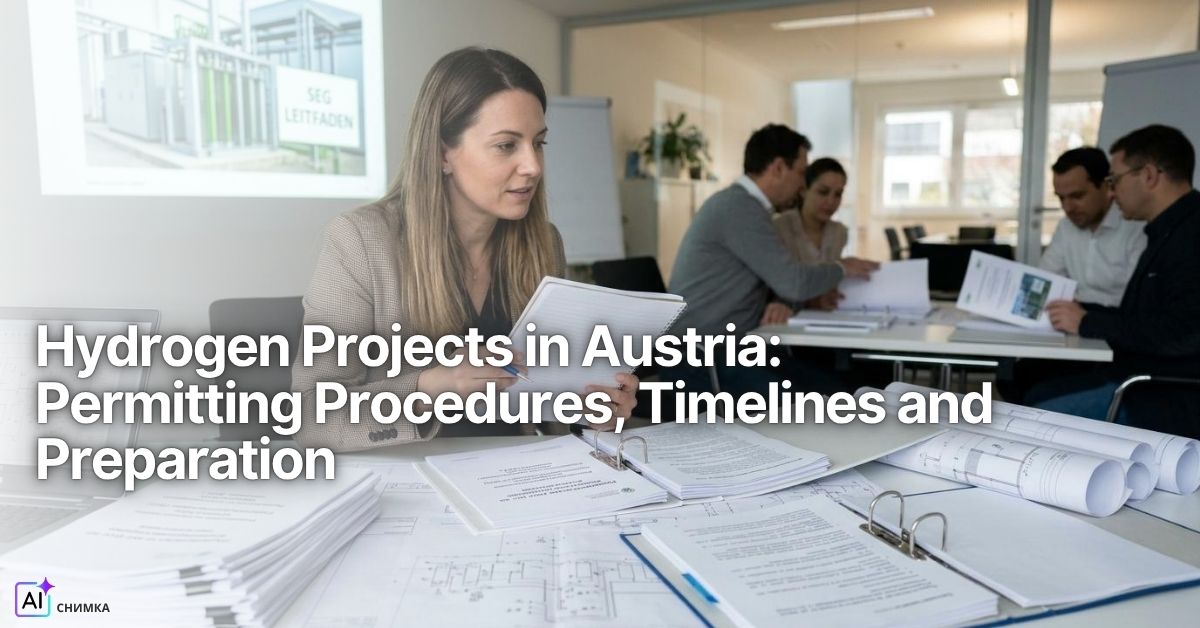
The permitting pathway for an electrolysis installation in Austria depends on the type of activity, its configuration and location. This is the approach followed by the guide published by the Servicestelle Erneuerbare Gase (SEG) in December 2024. SEG guide, pp. 8–9
Published by SEG in January 2025, the guide covers the production of renewable hydrogen through electrolysis, permitting procedures, environmental considerations, spatial planning and technical standards. It is intended to support both project developers and competent authorities. SEG: presentation of the guide
How the applicable regulatory regime is determined
The guide distinguishes between standalone electrolysers, installations connected to the electricity grid, and electrolysers integrated into an existing industrial facility. SEG guide, p. 9
According to the legal analysis from December 2024, the distinction between the Gewerbeordnung 1994 (GewO) and provincial electricity legislation (Landes-ElWOG) also depends on whether the operator carries out activities as an electricity undertaking. The existence of a grid connection alone is not sufficient to determine which regime applies. SEG guide, p. 30
In the procedural map presented by SEG, the early-stage checks include determining whether an environmental impact assessment (EIA) is required and whether the project is compatible with the designated land use. SEG webinar presentation, p. 9
Depending on the characteristics of the site, requirements relating to construction, water use and wastewater discharge, nature conservation, forestry, worker protection and technical safety must also be assessed. SEG webinar presentation, p. 16
Competent authorities and consolidation of procedures
Under the GewO, the competent authority at first instance is generally the district administrative authority (Bezirksverwaltungsbehörde), unless otherwise provided by law. GewO, Section 333
For procedures governed by Parts One and Two of the UVP-G 2000, the competent authority is the government of the respective federal province. The law also allows certain tasks to be delegated to district administrative authorities. UVP-G, Section 39
For construction procedures, the SEG guide identifies the mayor or the relevant municipal authorities as the competent bodies at first instance, with the specific rules depending on the federal province. SEG guide, p. 22
Where an EIA is required, Section 3(3) of the UVP-G provides for a concentrated procedure in which the relevant substantive requirements for project approval under federal and provincial law are applied, including matters falling within the municipalities’ own sphere of competence. UVP-G, Section 3
The GewO also consolidates certain permitting requirements, although to a more limited extent. Section 356b provides for the joint application of certain other federal provisions, including specified cases under water law. GewO, Section 356b
The simplified procedure is subject to more than one criterion
One of the criteria for the simplified procedure under Section 359b(1)(2) of the GewO requires both a total area of premises and other operational areas of no more than 800 m² and an electrical connection capacity of the machinery and equipment used of no more than 300 kW. GewO, Section 359b(1)
This constitutes a simplified permitting procedure: the decision issued has the legal effect of an installation permit. The law provides for an assessment of risks and impacts and allows conditions to be imposed in order to protect the interests concerned. GewO, Section 359b(3–4)
Installations subject to the Integrated Pollution Prevention and Control (IPPC) regime and establishments falling under Section 84b(1) are excluded from the simplified procedure. GewO, Section 359b(4)
Decision deadlines and overall project duration
The general rule under Section 73 of the Allgemeines Verwaltungsverfahrensgesetz 1991 (AVG) requires the administration to issue a decision without undue delay and no later than six months after receipt of the application, unless specific provisions establish a different deadline. AVG, Section 73
For the simplified procedure under Section 359b of the GewO, a specific two-month period applies following receipt of the application and its accompanying documents. GewO, Section 359b(4)
For EIAs, Section 7 of the UVP-G sets a deadline of up to nine months for projects listed in Column 1 of Annex 1 and up to six months for projects listed in Columns 2 and 3, calculated from the submission of the application. Under the conditions set out in paragraph 4, where the authority already possesses substantial and up-to-date knowledge from other procedures and the application is closely connected to them in time, these deadlines are shortened by three months. UVP-G, Section 7(2–4)
The same law requires a procedural timetable to be published online, updated in the event of significant changes, and any substantial overruns of that timetable to be explained in the permitting decision. UVP-G, Section 7(1)
These provisions establish deadlines for administrative decisions. On their own, however, they do not indicate the actual duration of hydrogen projects or how frequently the statutory deadlines are met. UVP-G, Section 7
Preparing documentation and digital submission
SEG recommends holding preliminary discussions with the competent authority and relevant experts, planning for the maximum anticipated future scope of the installation, and appointing an overall coordinator. The guide also emphasises the importance of assigning responsibilities clearly among the parties involved at an early stage. SEG guide, pp. 19 and 21
The official description of the EIA procedure in Lower Austria includes public access to the project documentation, an opportunity to submit comments, expert assessment and a decision. According to the procedure described, an oral hearing is held where comments or objections have been submitted in relation to the publicly available documentation. Lower Austria: stages of the EIA procedure
For the digital submission of project documentation, the federal province requires an electronic format including a table of contents and provides the WST1 template. Lower Austria: documentation and WST1
Austria’s Electronic Data Management (EDM) portal also includes the “IPPC Austria” application. EDM: IPPC Austria
Training for professionals and representatives of competent authorities
The “Basiswissen Wasserstoff” course presented on the ÖVGW website covers hydrogen production, storage, distribution, use and safety. Its target participants include professionals who require this knowledge in their work, as well as technical staff employed by gas network operators. ÖVGW: programme and participants
The hydrogen specialist training offered by TÜV AUSTRIA Akademie covers legal and administrative aspects, hazard and risk analysis, protective measures and a practical module on safety concepts. Representatives of competent authorities are explicitly included among the target participants. TÜV AUSTRIA: programme and participants
Sources
SEG — Guide to permitting renewable hydrogen production
SEG — Presentation of the guide
SEG — Webinar presentation, 12 February 2025
Gewerbeordnung 1994 — Section 333
Gewerbeordnung 1994 — Section 356b
Gewerbeordnung 1994 — Section 359b
Allgemeines Verwaltungsverfahrensgesetz 1991 — Section 73
Lower Austria — EIA procedures and WST1 documentation
EDM — Electronic Data Management portal
ÖVGW — Basiswissen Wasserstoff
TÜV AUSTRIA Akademie — Certified Hydrogen Specialist training