COP30 and the Role of Hydrogen in the Global Energy Transition
At COP30, hydrogen takes center stage as a key element of the global energy transition. The focus is placed on international cooperation, technological demonstrations, and the mechanisms needed to accelerate the deployment of clean fuels. One of the most notable developments is the signing of a memorandum of understanding between Belgium and Brazil aimed at advancing collaboration on green hydrogen, including future supply chains and expertise sharing.
Policy discussions highlight practical tools to unlock hydrogen projects – such as Contracts for Difference (CfDs), national mandates, and demand-aggregation schemes. Representatives from governments, industry, and finance explore how to jointly create the conditions needed to scale hydrogen and other sustainable fuels.

Technological innovation also takes the spotlight – including the demonstration of the world’s first green hydrogen-powered boat, showcasing the potential of carbon-free maritime transport. Discussions further emphasize the synergy between hydrogen, solar power, and energy storage as a solution to key energy challenges.
Despite strong interest, participants acknowledge that the sector is undergoing a natural “maturation phase,” marked by policy uncertainty and slow offtake in some areas. Expanding renewable power and integrating global carbon markets are seen as important factors for restoring sustainable momentum.
At COP30, hydrogen is firmly positioned as a crucial component of the broader energy transition – with relevance for aviation, shipping, and heavy industry. The goal is clear: turning global priorities into real partnerships, investments, and implementation mechanisms that accelerate the shift beyond fossil fuels.
How H2REF-DEMO Accelerates Europe’s Hydrogen Infrastructure
The H2REF-DEMO project, set to be completed in 2026, is taking a major step toward building reliable European hydrogen infrastructure for heavy-duty vehicles. Achieving net-zero requires innovative technologies, and this project demonstrates exactly that – a new generation of hydraulic compression capable of delivering hydrogen at an impressive 150 kg/hour with an energy consumption of under 3.5 kWh/kg.
In its final year, H2REF-DEMO will test a full-scale prototype of a refuelling station in France, where the system will undergo real-world operation and 500 hours of testing. The goal is to reach TRL 7 – a key milestone toward commercial deployment.
The project’s innovations include:
- Hydraulic direct-filling compression – a high-market-potential solution recognized by the Innovation Radar.
- High-Capacity Compression Module (HCCM) designed for heavy-duty vehicle refuelling.
- Bladder accumulators with new elastomer materials (ECO and HNBR) developed for hydrogen compatibility and compliance with new environmental regulations.
- Composite-reinforced shells for enhanced safety and extended lifespan.
- Digital twin for optimizing parameters such as flow rate, temperature, and pressure losses.
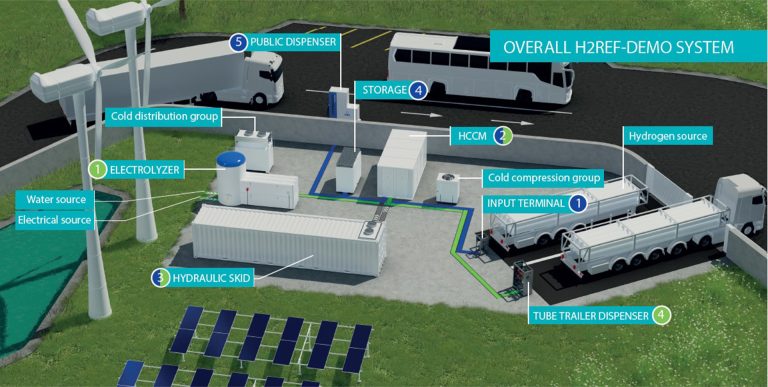
Thanks to its modular architecture and improved energy efficiency, the system can support up to 1.2 tonnes of hydrogen per day, making it valuable for bus depots, logistics corridors, and other key mobility points across Europe.
Supported by Horizon Europe through the Clean Hydrogen Partnership, the H2REF-DEMO project paves the way for scalable solutions that will support the decarbonisation of heavy transport and contribute to a more sustainable European future.
EU Hydrogen Research and Innovation Days 2025: A Look into the Future of Hydrogen Technologies
On 24–25 November 2025, the EU Hydrogen Research and Innovation Days 2025 will take place at the Sofitel Europe Hotel in Brussels. The event builds on the legacy of the former Programme Review Days and will gather leading representatives from the European Commission, industry, and the research community to discuss major challenges and recent achievements in hydrogen technologies.
The event will serve as a central platform to showcase progress across the Clean Hydrogen programme, offering opportunities to assess results, exchange insights, and identify new priorities for the sector. A particular emphasis this year will be placed on Hydrogen Valleys – regional initiatives demonstrating how local innovation accelerates Europe’s clean hydrogen transition.
With its strategic focus and high-level expertise, the EU Hydrogen Research and Innovation Days 2025 will contribute to strengthening Europe’s leadership in building a sustainable, competitive, and resilient hydrogen ecosystem.
https://set4h2.eu/set4h2-events/eu-hydrogen-research-and-innovation-days/