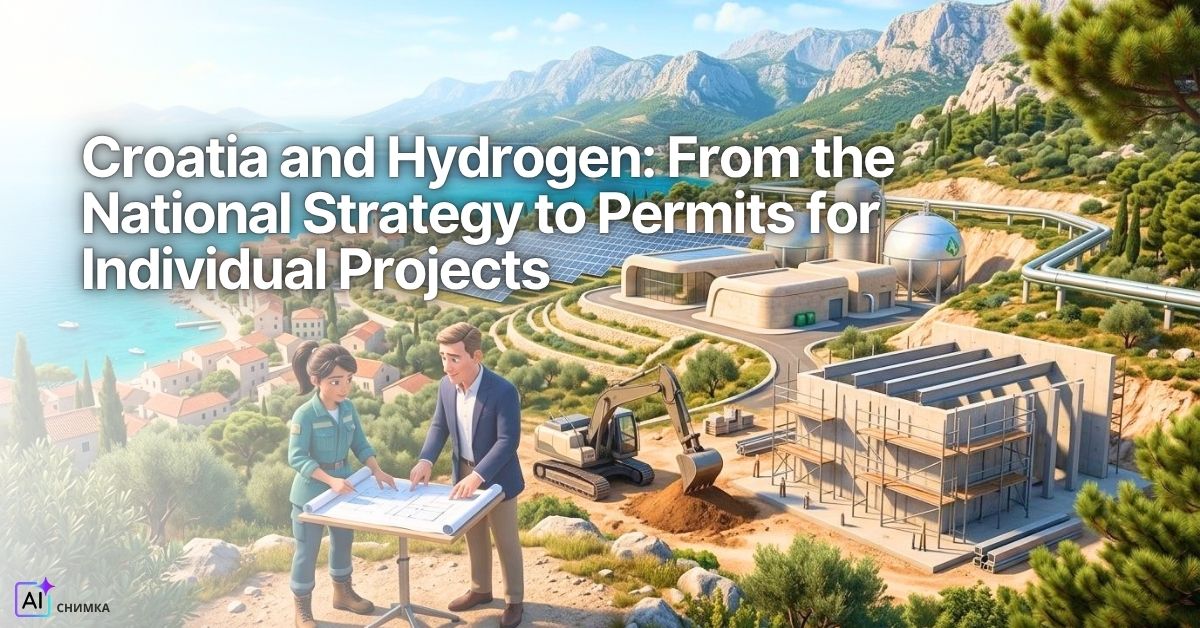
Croatia has made hydrogen part of its long-term energy policy through a strategy extending to 2050. Yet the documents supporting its implementation reveal how many issues must be addressed between setting a strategic objective and bringing a facility into operation. Hydrogen production, storage, transport and use fall under several legal and administrative frameworks. For project developers, this means identifying the requirements that apply to each component of an investment and the authorities responsible at every stage.
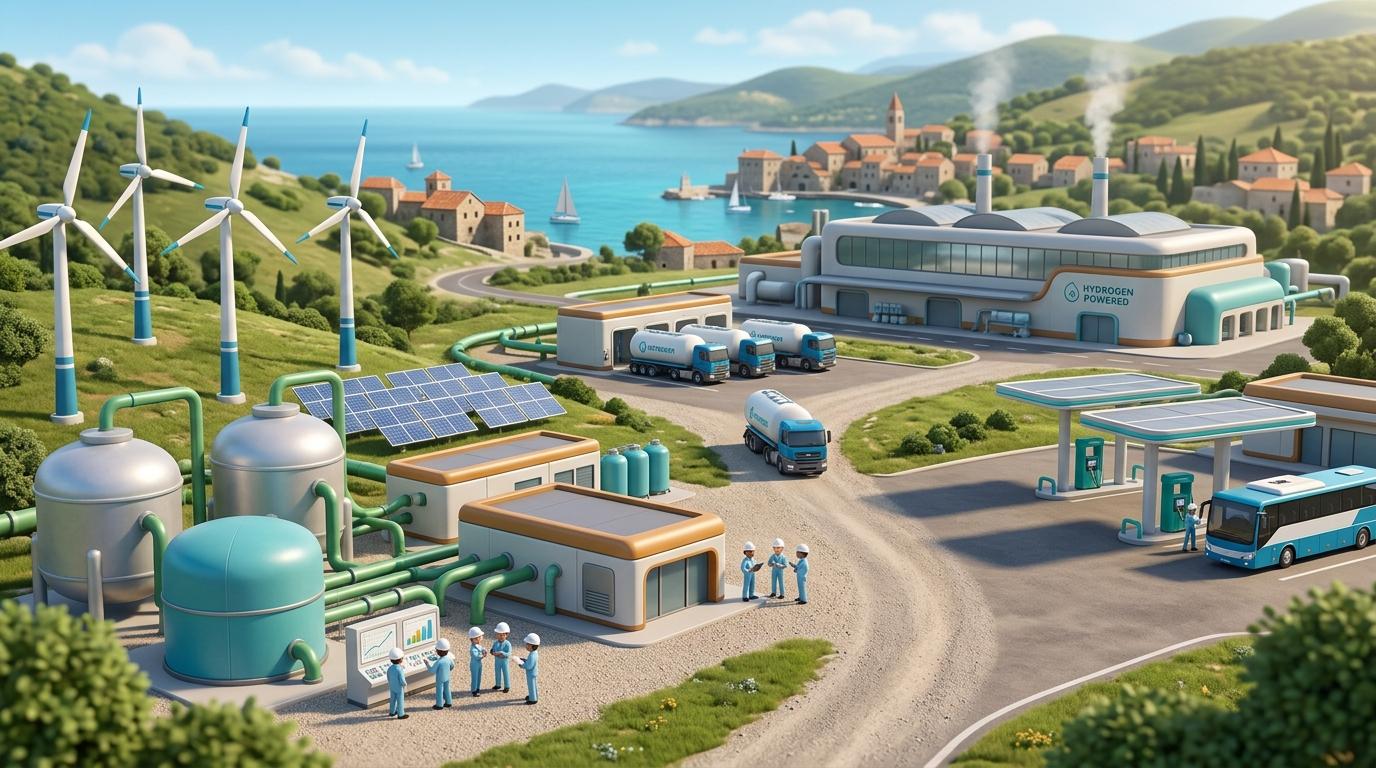
The national strategy adopted in 2022 covers four areas: hydrogen production; storage and transport; use; and education, research and development. It focuses on renewable hydrogen and its role in the transition to clean energy and sustainable mobility. Permitting therefore forms part of a wider challenge: developing an interconnected value chain from production to the end user.
Strategic framework and sector-specific rules
The strategy refers to existing legislation on biofuels in transport and alternative fuels infrastructure. It envisages the introduction of hydrogen alongside the development of primary and secondary legislation, as well as new standards for emerging technologies. This sets out a policy direction for the sector. The strategy itself does not constitute authorisation to construct or operate a particular facility.
A June 2024 study on implementing the strategy, published by Croatia’s Hydrocarbon Agency, maps the regulatory framework across the hydrogen value chain. For production, it examines energy legislation and renewable energy rules; for transport and storage infrastructure, it also considers gas market legislation. Hydrogen refuelling and its use in transport are addressed separately. This structure helps explain why a single project may be subject to different regulatory regimes, depending on the activities it involves.
The study’s authors recommend clearer permitting procedures for renewable hydrogen production and adapting the regulatory framework to its industrial use. These are recommendations, not evidence that all the proposed changes have already been adopted. Understanding the Croatian experience requires a clear distinction between procedures currently in place and proposed improvements.
Which authorities are responsible for which decisions?
The Croatian Energy Regulatory Agency (Hrvatska energetska regulatorna agencija, HERA) is responsible for licensing energy activities. The legislation governing the regulation of these activities establishes HERA as an autonomous, independent body vested with public powers. Its role must be understood in relation to the energy activity concerned and distinguished from construction and environmental permitting procedures.
Croatia’s official government portal identifies the competent city or county-level departments for construction and spatial planning as the authorities responsible for issuing building permits, according to the project’s location and their respective powers. For the relevant types of construction, the portal lists the main design documentation, proof of legal interest and other documents, as applicable, among the required attachments. Where a design review is mandatory, the corresponding written report must also be submitted. Project preparation therefore involves both the technical design and the legal basis for developing the facility at the chosen site.
Additional stakeholders become involved when an investment includes electricity generation and participation in the electricity market. Croatia’s official Point of Single Contact describes a network-use agreement with the transmission system operator HOPS and/or the distribution system operator HEP-ODS, along with a market participation agreement with HROTE. These requirements concern the electricity component of an investment. Whether they apply to a particular hydrogen project depends on its electricity supply arrangements and business model for market participation.

What does the energy regulator assess?
The Rules on Licensing Energy Activities, published as NN 44/2022, require applicants to demonstrate technical, professional and financial qualifications. Technical readiness includes having the necessary facilities and documentation authorising their use in accordance with spatial planning and construction rules. Professional capacity requires a sufficient number of appropriately qualified employees. Applicants intending to undertake several energy activities must submit a separate application for each one.
Article 12 sets a 30-day deadline for a decision following submission of a duly completed application and all required documentation. The period is 60 days where verification of information and inspection of buildings, installations or equipment are necessary. These deadlines apply to HERA’s licensing decision. They do not automatically cover project preparation or every other stage of the permitting process. The rules also require licensees to maintain the relevant qualification requirements throughout the licence period.
Environmental assessment and operating conditions
The official description of the environmental permitting procedure links this regime to the Environmental Protection Act and the regulation governing environmental permits. Its purpose is the integrated prevention and control of pollution from industrial activities. Facilities falling within its scope must obtain an environmental permit before commencing operations, including trial operation. Where an environmental impact assessment (EIA) is required, the environmental permit is issued after the decision confirming the project’s environmental acceptability.
The procedure involves an application supported by expert documentation, a completeness check and consultation with the competent authorities. If information is missing, the applicant is given a period to address the deficiencies, which may not exceed 30 days. Official guidance also identifies best available techniques (BAT) as the basis for setting permit conditions. Environmental preparation must therefore address the specific characteristics of the installation and how its impacts will be controlled.
The regulation requires the installation description to cover its activities, process techniques and measures, location and emission points. A site plan and, where applicable, process flow diagrams form part of the documentation. This enables operating conditions to be assessed against the specific facility rather than merely the project’s general description.
Public participation is subject to its own time limits. Article 16 requires information about a duly submitted application to be made publicly available for at least 30 days. The draft permit must be available for public inspection for at least 15 days, and comments may be submitted within eight days following the end of the publication period. These stages need to be factored into the permitting schedule rather than conflated with the deadline for licensing an energy activity.
Statutory deadlines versus actual processing times
The General Administrative Procedure Act also distinguishes between different types of cases. Article 101 provides for a decision within 30 days where a duly submitted application can be decided directly, and within 60 days where an examination procedure is required to establish the facts. The law also provides for an appeal or an administrative court dispute if an authority fails to issue a decision within the prescribed period. These provisions govern administrative decisions in the proceedings to which they apply.
The official guide to permitting renewable electricity generation shows that statutory deadlines and actual processing times can differ. It notes that screening to determine whether an environmental impact assessment is required (OPUO) may take six months or longer. A full environmental impact assessment (PUO) may take more than a year. For a full assessment, the guide cites a statutory period of four months from receipt of a duly submitted application, with a possible extension of up to two months if additional steps are needed.
These observations relate to the environmental procedures described for renewable electricity generation projects. They provide useful context for understanding the permitting environment but do not establish an average timeline for all hydrogen investments in Croatia. Nor can they be used to calculate a single overall period from the initial project concept to the commercial operation of a hydrogen facility.
Electronic applications and project-specific requirements
The eDozvola system allows applicants to enter information electronically, attach supporting documents and design files, and track the progress of a building permit application. However, the government portal notes that the pace of permit issuance depends on how the competent city and county authorities organise their work. Having a shared digital tool does not, in itself, mean that all applications will be processed within the same timeframe.
The official eDozvola guidance distinguishes between completing an application without authenticated identification and submitting it fully online through the national identification system. Under the first option, the generated reference identifier must be followed by formal submission through the registry office; the fully electronic route results in a registered application. The guidance also explains how to access case files electronically. This provides practical support for document handling and traceability in construction permitting procedures.
A practical example is the environmental report for a proposed hydrogen project in the municipality of Lećevica, Split-Dalmatia County. Prepared by Elektroprojekt in 2023, the document describes an integrated development comprising a hydrogen production facility, a solar photovoltaic plant, battery energy storage and access infrastructure. The plan envisages using electricity from the solar plant to power electrolysis in a stand-alone configuration, without exporting electricity to the grid.
The example illustrates why the specific project configuration matters: electricity supply, site areas and supporting infrastructure are documented as components of a single investment. The report describes a proposed development and technical design as they stood when it was prepared. The existence of this documentation does not, by itself, establish that the facility has been commissioned or is currently producing hydrogen.
Training the people responsible for applying the rules
Training is another part of administrative and technical preparedness. The Zagreb Energy Centre’s Hydrogen Competence Centre presents an educational programme for engineers, researchers, decision-makers and public-sector professionals. Its intended audience reflects the connection between technological expertise, institutional responsibilities and the development of new projects. The programme is a documented training initiative, although the page does not publish an assessment of its effect on permitting timelines.
The study on implementing the national strategy includes a plan for obtaining the necessary permits and approvals among the elements of a business plan for pilot hydrogen projects. For each project, the next verifiable step remains identifying the procedures that apply to its particular technology, location and activities.

Croatia’s experience is particularly relevant to Bulgaria, where clear permitting procedures and coordination between institutions are important prerequisites for hydrogen project development. The Bulgarian Hydrogen, Fuel Cell and Energy Storage Association (BGH2A) is already working in this area through its participation in the European project PermittHy, which aims to strengthen expertise and improve permitting procedures. The Association has also proposed specific measures to simplify administrative requirements as part of the update to Bulgaria’s National Hydrogen Roadmap. These efforts form part of its wider work to create a predictable regulatory environment and enable hydrogen investments to move forward in Bulgaria.
Sources
- Croatian Hydrogen Strategy to 2050, 2022
- Hydrocarbon Agency: Study on the Implementation of the Hydrogen Strategy, June 2024
- Act on the Regulation of Energy Activities
- Rules on Licensing Energy Activities, NN 44/2022
- Gov.hr: Building Permits
- Point of Single Contact: Electricity Generation
- Ministry: Environmental Permitting Procedure
- Regulation on Environmental Permits and the 2018 amendments
- General Administrative Procedure Act
- Official Guide to Permitting Renewable Electricity Generation
- eDozvola: Official Instructions for Applicants
- Elektroprojekt: Environmental Report for the Lećevica Hydrogen Project
- Zagreb Energy Centre: Hydrogen Competence Centre