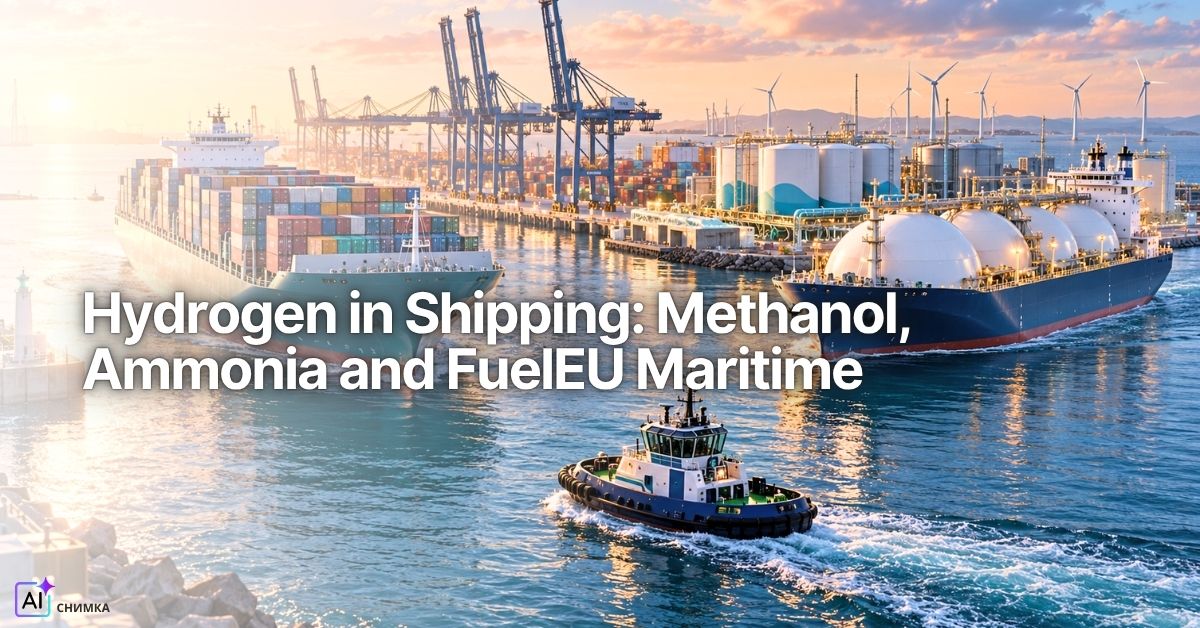
The European regulation does not choose a winner among fuels in advance. It sets a measurable carbon performance target, for which the origin of hydrogen, the supply chain, shipboard technology, and actual emissions all matter.
There is no single universal hydrogen-based solution for shipping. Hydrogen can serve as a feedstock for other energy carriers, most notably synthetic methanol and ammonia. Both can be used as marine fuels, but they differ significantly in technological maturity, risk profile, and pathways to low emissions.
As of September 2026, methanol is further ahead in commercial operation, while ammonia is moving from testing towards its first ocean-going applications. In the EU, the choice between them is now being made within a new framework: FuelEU Maritime does not reward the name of the molecule, but rather the annual greenhouse gas intensity of the energy used over its entire life cycle.
What FuelEU Maritime Requires
Regulation (EU) 2023/1805 has applied in full since 1 January 2025 to ships above 5,000 GT engaged in the commercial transport of passengers or cargo and calling at ports under the jurisdiction of EU Member States, regardless of their flag.[1]
Its scope covers 100% of the energy used on voyages between such ports and while at berth, as well as 50% of the energy used on voyages to or from a third country.[2]
There are exemptions and specific derogations, so the regulation’s applicability to each vessel must be assessed against the regulation itself and the vessel’s voyage profile. As of the date of this article, the European Commission states that Norway and Iceland are treated as third countries under FuelEU Maritime until the regulation is incorporated into the EEA Agreement.[3]
The objective is to reduce the annual average greenhouse gas intensity of energy used on board compared with the 2020 reference value: by 2% in 2025, 6% in 2030, 14.5% in 2035, 31% in 2040, 62% in 2045, and 80% in 2050.[1] This is not a rule prescribing a specific percentage of any particular fuel. Shipping operators can combine different measures, and the regulation also allows voluntary pooling of compliance between vessels.[2]
The most important detail is the well-to-wake methodology, which covers emissions from production and supply through to use on board. It includes CO₂, methane, and nitrous oxide (N₂O).[3] Consequently, a ship running on methanol or ammonia does not automatically become low-emission simply by replacing its engine. The specific fuel pathway must also be traceable.
FuelEU Maritime provides for a multiplier of 2 in the calculations for renewable fuels of non-biological origin (RFNBOs) until the end of 2033. However, a potential 2% RFNBO sub-target from 2034 is not a requirement currently in force: it depends on data for 2031 and an assessment by the European Commission.[1] In parallel, the regulation provides for the use of shore-side electricity or another zero-emission technology at berth for certain container and passenger ships from 2030, and in other cases from 2035, where the relevant capacity is available.[3] Port electrification and the fuel transition are therefore progressing together, but they are not interchangeable.
For Bulgarian companies supplying energy, equipment, certification, or services to the maritime sector, this represents a practical change even before a primary alternative fuel is selected locally. Decisions concerning a specific voyage must link the fuel contract to proof of origin, vessel data, port capabilities, and the allocation of responsibilities along the supply chain. Announced production capacity alone, or a project designated as ammonia-ready, is not sufficient to demonstrate compliance.
Why Methanol Is the More Practical First Step
Methanol is liquid at ambient temperature and pressure. This makes storage and bunkering easier compared with cryogenic solutions, although its lower volumetric energy density requires more space for fuel. DNV considers methanol engines and shipboard systems to be technologically mature, but identifies access to low-emission methanol as a key limitation.[4]
The important distinction is between an engine capable of running on methanol and the actual climate outcome. Conventional methanol is not equivalent to renewable or low-carbon methanol. Biomethanol and synthetic e-methanol can reduce the life-cycle footprint when appropriate feedstocks, electricity, and certification are used. In the case of e-methanol, the carbon performance depends on renewable hydrogen, the carbon source, and the energy used.[5] FuelEU Maritime will account for this entire chain, rather than the fuel’s marketing designation.
The market development is already visible, but it should not be overstated. Maersk reports that it had 19 dual-fuel methanol vessels in operation by the end of 2025, following the delivery of another 10 during that year.[6] This represents real-world deployment of the technology, but a dual-fuel vessel retains the ability to operate on conventional fuel. These figures alone do not demonstrate how much sustainable methanol has actually been bunkered. DNV’s industry data also show that the investment cycle is not following a straight line: orders for methanol-fuelled vessels amounted to 61 in 2025, compared with 149 in 2024.[7] Orders, deliveries, and actual quantities of low-emission fuel used are three different indicators.
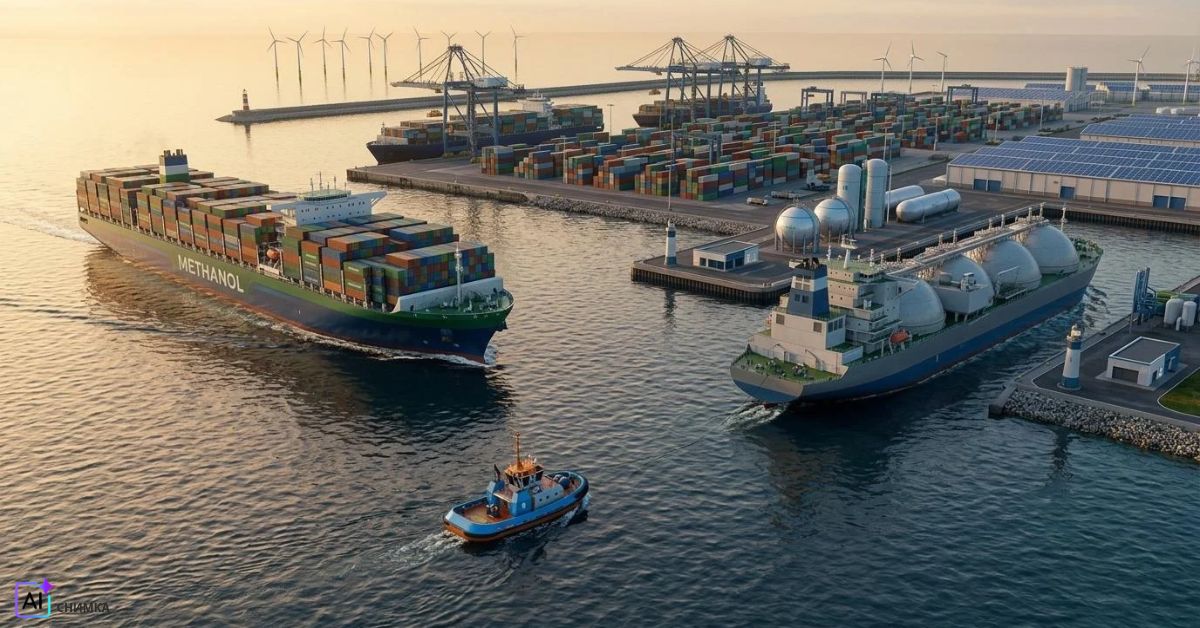
Ammonia: From a Promising Fuel Carrier to the First Ocean-Going Vessel
Ammonia contains no carbon, making it an important option for long-distance voyages. In a configuration that uses ammonia as the primary fuel, this can reduce direct CO₂ emissions compared with a carbon-based fuel. However, in a dual-fuel engine, the share of pilot fuel also matters. The climate outcome depends first on production: ammonia made from hydrogen produced using electricity with a high carbon intensity does not automatically meet the low-emission objective. The European Commission summarises scenario-based modelling showing that the air-quality impacts of ammonia combustion depend on engine technology and emission controls. The analysis considers N₂O, NOₓ, unburned ammonia, and secondary fine particulate matter.[8]
The status of the technology changed in 2026. On 10–11 June, EXMAR and engine manufacturer WinGD announced the delivery of ANTWERPEN, a dual-fuel gas carrier which, according to the companies, is the first ocean-going vessel designed to use ammonia as fuel.[9]
Sea trials and delivery move the discussion beyond an ammonia-ready project: an ocean-going vessel has now been delivered. Nevertheless, this is an early stage, not proof of fleet-wide readiness or of a specific measured carbon performance. DNV reported limited activity in new ammonia-fuelled vessel orders during 2025.[7]
Safety is just as important as the carbon balance. Ammonia is toxic, corrosive, and highly soluble in water. The European Maritime Safety Agency (EMSA) analyses leak scenarios, fuel systems, and simultaneous operations in ports.[10]
The International Maritime Organization (IMO) already has interim safety guidelines for ships using ammonia as fuel.[11] These provide a regulatory foundation, but they do not eliminate the need for project-specific risk assessments, reliable detection systems, emergency procedures, training, and coordination with port authorities.
What This Means for Decisions in the Coming Years
The available data indicate that methanol is the option closer to the market: it has operational engines, vessels in service, and more familiar liquid-fuel logistics.[4][6] The main question is whether sufficient certified low-emission methanol will be available. Ammonia offers a pathway without carbon in the molecule itself and can serve as a carrier for renewable hydrogen, but it is still building a proven operational track record, bunkering rules, and safe operating practices in ports.[9][10][11]
The most meaningful question, therefore, is not which of the two energy carriers will ultimately emerge as the winner, but which verifiable fuel pathway and which combination of shipboard and port measures can meet the target for a specific voyage. FuelEU Maritime encourages precisely this approach: technology-neutral, measured over the entire life cycle, and accountable for actual emissions. For companies, fuel suppliers, and ports, this shifts the focus towards proof-of-origin agreements, certification, bunkering readiness, training, and data. Hydrogen remains central to both pathways, but its value for shipping will be determined by the entire system surrounding it.
References
- Regulation (EU) 2023/1805 — FuelEU Maritime, Articles 2, 4 and 5.
- EMSA: FuelEU Maritime Regulation.
- European Commission: FuelEU Maritime.
- DNV: Methanol in Shipping and Methanol for Container Vessels.
- IEA: Putting CO₂ to Use.
- Maersk: Asset Efficiency.
- DNV: Alternative-Fuel Orders, 2025.
- European Commission: Modelling Ammonia’s Impact on Air Quality.
- EXMAR: Delivery of ANTWERPEN and WinGD: Delivery of ANTWERPEN.
- EMSA: Safety of Ammonia as a Fuel in Shipping.
- IMO: MSC.1/Circ.1687 — Interim Guidelines for the Safety of Ships Using Ammonia as Fuel.