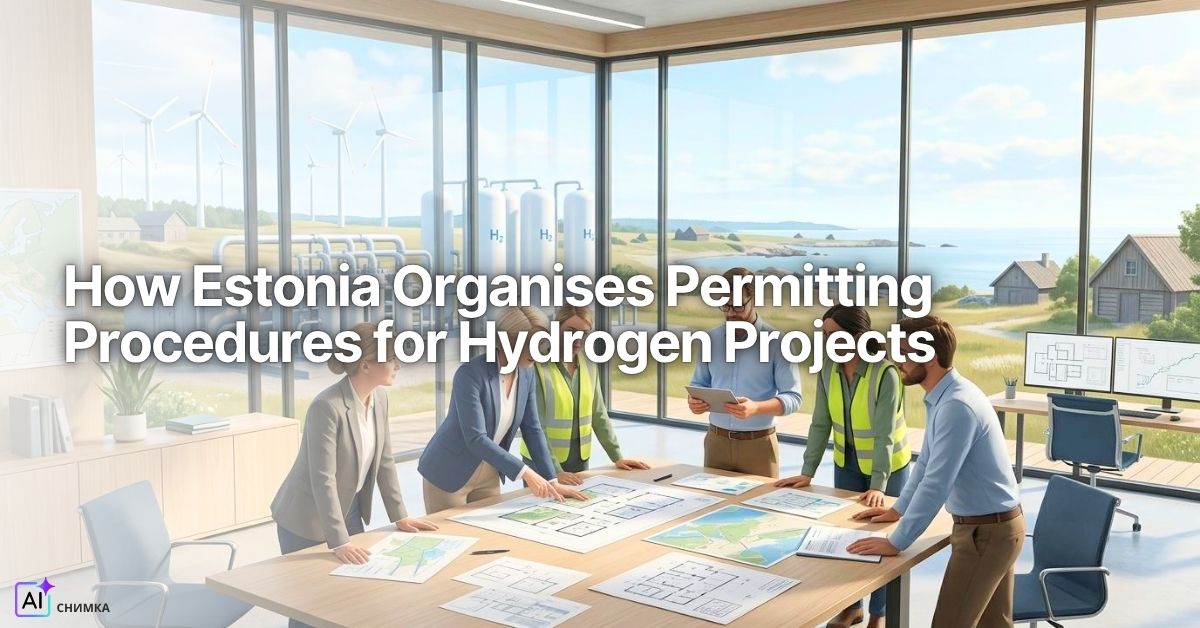
Estonia’s approach to hydrogen combines environmental permitting, safety requirements and digital administrative services. For investors, the key question is how these procedures fit together within a specific project. Access to digital services is only one part of project preparation. Environmental impact assessment and safety requirements remain separate tasks.
The Roadmap Sets the Direction
Estonia’s National Hydrogen Roadmap, published in 2023, identifies the period up to 2030 as a phase for testing and developing hydrogen technologies. The Ministry of Climate lists policy development, research, pilot projects and improved access to renewable energy among its priorities. This places permitting within a broader objective: creating the conditions for hydrogen production, supply and utilisation chains. Ministry of Climate.
The roadmap also identifies unclear and lengthy permitting procedures for renewable energy and hydrogen as a weakness. It also highlights a shortage of qualified specialists. This assessment comes from a strategic document published in 2023 and does not measure the outcomes of subsequent legislative changes. Its significance lies in showing which obstacles the government had recognised when shaping its policy. Hydrogen Roadmap, p. 15.
Coordination Has a Clearly Defined Scope
The current version of Estonia’s Energy Sector Organisation Act includes a definition of renewable hydrogen and rules governing its Guarantees of Origin. The same legislation designates the Ministry of Climate as the contact point for permitting renewable energy projects, while the Building Register, Ehitisregister, performs the functions of a contact point within the relevant procedure.
Where a project falling within the scope of these rules requires an environmental impact assessment as part of the permitting process, the legislation provides for a single comprehensive assessment containing information on the necessary permits. Whether these provisions apply to individual components of a hydrogen project must be determined against the statutory definitions. The general rules governing renewable energy installations do not, in themselves, establish that every electrolyser, hydrogen storage facility or hydrogen pipeline is subject to the same regulatory regime. Act, § 2, § 32¹, § 32⁷ and §§ 32¹⁶–32¹⁸.
The environmental permitting process has a clearly designated administrative channel. Estonia’s Environmental Board, Keskkonnaamet, explains that applications for environmental permits have been accepted through the KOTKAS information system since 2020. KOTKAS allows applications for both environmental permits and integrated environmental permits. The latter are required for certain industrial activities posing a high environmental risk and bring together environmental protection requirements, including the application of Best Available Techniques (BAT) and compliance with emission limit values. Keskkonnaamet.
For project teams, this means distinguishing between the system used to submit documentation and the substantive requirements of the permit. A single digital portal does not, in itself, determine which environmental impacts must be assessed or which technical conditions must be met.
Environmental Assessment and Safety Address Different Requirements
Keskkonnaamet describes environmental impact assessment (EIA) as a procedure whose findings are taken into account when deciding whether to grant the relevant permit. Where an assessment is not automatically mandatory, certain activities undergo preliminary screening to determine whether one is required. The process also includes public participation, allowing members of the public to review documentation, submit comments and take part in public discussions. Environmental impact assessment guidance.
Industrial safety requirements introduce another set of documents. Estonia’s Consumer Protection and Technical Regulatory Authority (TTJA) classifies establishments into three categories according to the maximum quantities of hazardous chemicals that may be present on site. Category C requires an information sheet, a risk assessment and an emergency plan. Category B additionally requires a description of the safety management system. Category A also requires a safety report incorporating the risk assessment and the description of the safety management system.
The documents must be submitted to TTJA for review and kept up to date. Preparing a hydrogen production or storage site therefore requires clarity about the substances involved and their quantities from the design stage onwards. The rated capacity of the production equipment alone does not indicate the maximum quantities of hazardous chemicals on site, which TTJA uses to determine the establishment’s classification. TTJA — Mandatory Documentation.
A Permitting Deadline Is Not a Project Completion Deadline
The legislation establishes a general maximum period of two years for the permitting procedure for certain onshore renewable energy installations, with different time limits applying to some project categories. Possible extensions and excluded periods are also provided for. The time limit does not include construction, certain grid connection activities, checks on the completeness and formal compliance of the application, the completion of the environmental application specified in the legislation, or the pursuit of legal remedies. This is a statutory framework applying to a defined scope of projects, not a measured timeframe for completing a hydrogen project. Act, § 32¹⁹.
Assessing administrative practice requires data from cases that have actually been concluded: when a complete application was submitted, what additional information was requested and when the decision was issued. The existence of a statutory deadline is not sufficient evidence to claim that it is routinely met.
The Hydrogen Corridor Demonstrates the Role of Planning
A specific example is the spatial planning process for the Estonian section of the Nordic-Baltic Hydrogen Corridor. The project envisages a hydrogen transport connection linking Finland, Estonia, Latvia, Lithuania, Poland and Germany. In March 2026, a national designated spatial planning procedure was initiated for the Estonian onshore section.
Elering explicitly states that initiating the procedure does not mean that a decision has been made to construct the pipeline or that a specific route has been selected. The potential options will be subject to public consideration during the planning process. This distinction is important for municipalities, landowners and future users: planning establishes the conditions for infrastructure development before construction can be considered. Elering.
Qualified Specialists Are Essential to Implementation
In November 2025, Virumaa College of Tallinn University of Technology (TalTech) delivered a course on the fundamentals of hydrogen technologies worth 6 credits under the European Credit Transfer and Accumulation System (ECTS), as part of the H2CoVE project. The training was primarily aimed at Master’s students, although its content was also suitable for Bachelor’s students and engineering professionals. It covered hydrogen production, safety, storage, transport and applications.
In its announcement of the pilot course, TalTech also outlined plans for additional modules, including hydrogen safety and safety management. TalTech.
For Bulgarian hydrogen initiatives, a useful lesson from Estonia’s experience is the need to develop a comprehensive plan from the outset, covering permitting procedures, responsible authorities and the information required for each decision. This should be accompanied by a realistic timetable, early risk assessment and training tailored to the roles of those involved. In this way, digital services can be combined with clear project preparation and traceable accountability at every stage.
PermittHy
Estonia’s experience is directly relevant to the objectives of the European PermittHy project, which aims to improve permitting and licensing procedures for hydrogen projects through the analysis of regulatory practices, the exchange of good practices and specialised training. The project examines approaches in different European countries, identifies administrative bottlenecks and develops practical guidance and training materials for staff of competent authorities and other stakeholders involved in the process. The Bulgarian Hydrogen, Fuel Cell and Energy Storage Association (BGH2A) is a partner in PermittHy and contributes to the analysis of permitting procedures, the development of training content and the organisation of training courses in Bulgarian.
Sources
Estonian Ministry of Climate — Hydrogen
Estonian Hydrogen Roadmap, 2023 — PDF
Energy Sector Organisation Act
Keskkonnaamet — Environmental Permits
Keskkonnaamet — Environmental Impact Assessment
TTJA — Mandatory Safety Documentation
Elering — Nordic-Baltic Hydrogen Corridor
TalTech — Pilot Hydrogen Training Courses under the H2CoVE Project