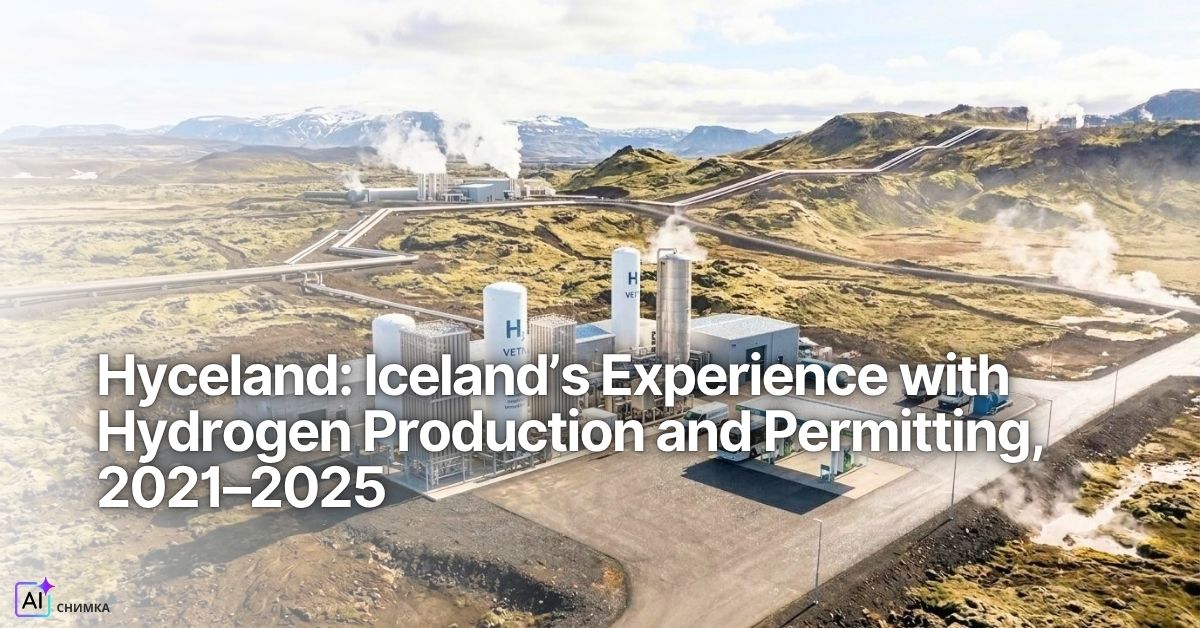
In August 2022, the Icelandic Environment Agency, Umhverfisstofnun, reviewed a proposed amendment to the permit for the VON hydrogen station at Hellisheiði. The operator, Orka náttúrunnar, planned to apply for authorisation to produce up to 130 tonnes of hydrogen annually using its existing equipment. The case provides a concrete example of the permitting issues associated with hydrogen production in Iceland.
The materials concerning Hyceland cover this broader national context, including hydrogen production through electrolysis, project feasibility studies and permitting procedures. The examples below illustrate the regulatory and operational environment for hydrogen development in Iceland. The documents do not establish that all the facilities and initiatives discussed are part of the Hyceland hydrogen valley itself.
In its opinion dated 26 August 2022, Umhverfisstofnun stated that Orka náttúrunnar had been operating VON since 2020. The production process uses electricity from Hellisheiðarvirkjun and water from the power plant’s water supply. Electrolysis takes place during periods of low electricity demand, and the hydrogen produced is compressed into vessels.
The permit issued on 7 January 2021 authorised production of just under 100 tonnes per year. The proposed increase to 130 tonnes in 2022 represented a subsequent step in the permitting process. These two figures refer to an authorised production volume and a planned application, rather than verified actual annual production.
The same document also addressed the need for an environmental impact assessment. The agency expressed the view that, under the specified conditions, including compliance with the requirements of the new permit and the application of best available techniques, no significant environmental impact requiring such an assessment was expected. This assessment concerned the specific installation, its scale and its location.
Another example comes from Ölfus. An article published by Ölfus Cluster on 26 March 2021 reported a collaboration between the municipality, engineering company EFLA and Summa to assess the feasibility of a facility for water electrolysis and the production of hydrogen and its derivatives. The source described the initiative as an early-stage project. It confirms that a feasibility study had been initiated but does not establish that a facility had been constructed and brought into operation.
Broader applications were examined in the June 2021 report “Fýsileiki þess að framleiða rafeldsneyti á Íslandi”. The analysis focused on synthetic fuels based on hydrogen produced through electrolysis using renewable electricity. It examined ammonia, methane, methanol and a synthetic substitute for crude oil, as well as potential applications in transport and industry. The report assessed production feasibility and technological possibilities.
The permitting framework involves several types of administrative decisions. Guidance issued by Umhverfis- og orkustofnun (UOS), the Environment and Energy Agency, defines an operating permit for a business activity — starfsleyfi — as written authorisation for a specific activity, either in whole or in part. The competent authority depends on the category of activity: the guidance distinguishes between cases handled by UOS and those falling within the jurisdiction of municipal health committees.
Separately, the municipality of Ölfus describes framkvæmdaleyfi as a municipal permit for substantial works that affect the environment and alter its appearance. Such works must comply with spatial planning requirements, and applications must be submitted to the responsible planning officer in the relevant municipality. This distinction helps clarify both the conditions governing the execution of works and those applying to subsequent business operations.
Electricity generation is subject to its own permitting procedure. Official UOS guidance states that the agency issues permits for the construction and operation of power plants. Supporting documentation includes a description of the plant, an implementation schedule, financing arrangements, grid connection agreements, information on the main environmental impacts and details of other required permits. These requirements apply to power plants and should not automatically be treated as identical requirements for every electrolyser.
Completeness of documentation is also part of the administrative process. According to the description of building procedures in Reykjavík, applications are considered at a meeting once all relevant documents have been received and the case officer’s review has been completed. The source identifies a condition for an application to proceed but does not, in itself, establish how frequently incomplete documentation causes delays to hydrogen projects.
Permitting timelines also require careful interpretation. The 2022 opinion concerning VON refers to an administrative timeframe of up to 240 days for issuing an operating permit, calculated from receipt of a complete application. This is not a record of the actual duration of the specific case, nor does it establish an average processing time for all hydrogen installations. Similarly, the 12-month period indicated on the Ölfus website refers to the validity of a permit following municipal approval.
On 22 November 2024, Iceland’s Ministry of the Environment, Energy and Climate published a proposal to simplify and coordinate permitting procedures. Measures proposed at the time included moving towards a single administrative point of contact through UOS, expanding the possibility of registration rather than permitting for certain activities, and coordinating decisions on alterations to bodies of water with the permitting of the relevant projects. The announcement outlined reform objectives and proposals. It did not report any measured reduction in permitting times.
A specific legislative change followed with Act No. 42 of 26 June 2025, which amended the legislation governing electricity and water management. The Act introduced the possibility of temporarily authorising activities relating to power plants in exceptional cases of urgent necessity. Where a project falls within the scope of environmental assessment legislation, an assessment or a decision on whether such an assessment is required must be in place.
For this specific procedure, the Act provides for a decision no later than four weeks after receipt of a complete application and a period of at least two weeks for written comments following its public notification. Temporary authorisation may be granted for up to one year and extended for a further period of up to one year, provided the relevant conditions are met. These deadlines apply to the special procedure for power plants.
The Act also provides that, where a project requires authorisation from UOS and involves an alteration to a body of water requiring approval, the request for that alteration must be submitted together with the application for the relevant permit. The decision concerning the body of water then becomes part of the agency’s decision on the project’s authorisation. This legislative change therefore concerns the integration of two administrative decisions. It does not, in itself, demonstrate faster permitting for Hyceland, but it identifies precisely which element of the procedure has been consolidated.
Sources
- Umhverfisstofnun — Opinion concerning the hydrogen station at Hellisheiði, 26 August 2022, pp. 1–2.
- Ölfus Cluster — Study on hydrogen production through electrolysis, 26 March 2021.
- “Fýsileiki þess að framleiða rafeldsneyti á Íslandi” — Feasibility report on synthetic fuel production, June 2021, pp. 3 and 22–26.
- UOS — Guidance on operating permits for business activities.
- Municipality of Ölfus — Permits for the execution of works.
- UOS — Guidance on permits for the construction and operation of power plants.
- City of Reykjavík — Building procedures and application processing.
- Government of Iceland — Proposal to simplify permitting procedures, 22 November 2024.
- Alþingi — Act No. 42 of 26 June 2025, Articles 1 and 5.