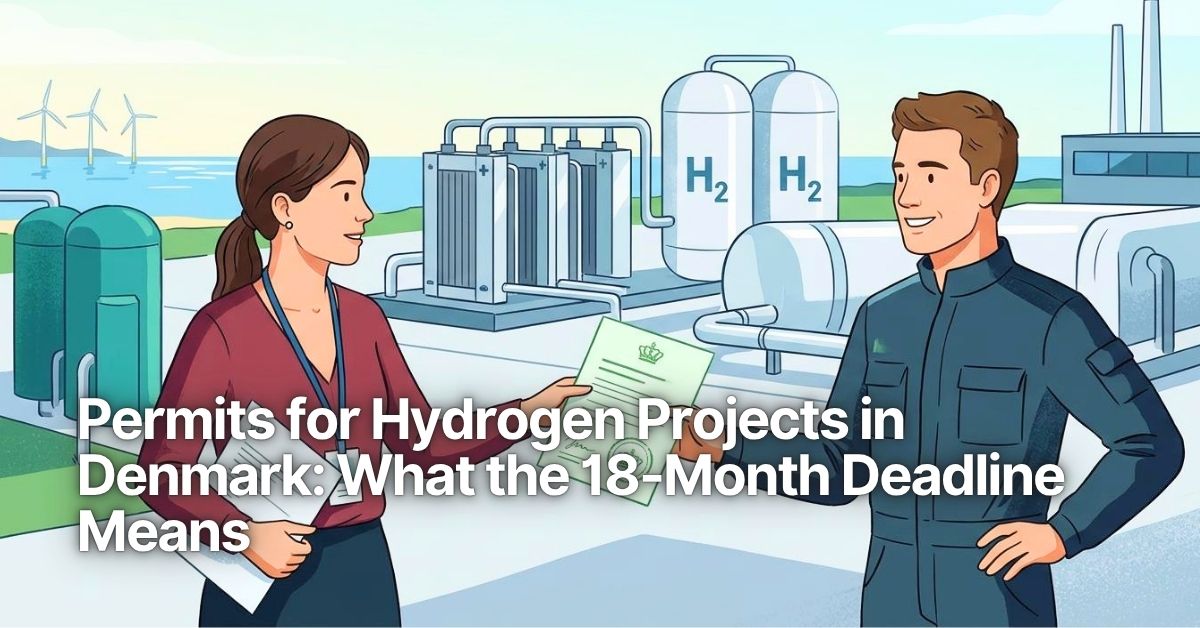
Denmark uses a combination of environmental permits, environmental impact assessment and safety regulations for hydrogen projects. A one-stop shop can coordinate procedures for eligible manufacturing enterprises, but the 18-month deadline has specific limits: it begins once the case has been fully clarified and does not include all stages of environmental impact assessment (EIA).
Who Issues the Environmental Permit?
The Danish Environmental Protection Agency lists industrial-scale hydrogen production by electrolysis under item 4.2(a)(ii) of the list of activities that may require an environmental permit. The permit sets out the conditions under which a specific installation may operate.
As a general rule, the municipality is responsible for permitting and supervision of hydrogen production by electrolysis. However, the allocation of responsibility also depends on other activities and risks at the site. The Danish Energy Agency states that when a hydrogen production facility falls into the upper tier of establishments subject to major-accident regulations, the national environmental agency is the competent authority. The agency also handles many projects in which hydrogen is converted into ammonia, methanol or other products.
This is an important distinction for Power-to-X (PtX) projects, in which electricity is used to produce hydrogen and, where necessary, other substances. The competent authority is determined on the basis of the entire project, including the activities and risks at the site.
Risk Also Depends on the Quantity of Hydrogen Present
According to the Danish Environmental Protection Agency, the hydrogen quantity thresholds under the major-accident regime are 5 tonnes for lower-tier establishments and 50 tonnes for upper-tier establishments. The maximum quantity that may be present at any given time is taken into account, rather than annual production. Where multiple hazardous substances are present, a specific aggregation rule also applies.
Environmental requirements are accompanied by additional procedures. For example, the Danish Energy Agency’s official guidance states that the safety authority must be notified of new hydrogen production facilities before construction, together with a risk assessment and supporting documentation.
Environmental Impact Assessment and Environmental Permits
Before deciding whether to issue an environmental permit, it is necessary to establish whether the Environmental Assessment Act applies. Projects listed in Annex 1 are subject to assessment, while for those listed in Annex 2, the competent authority determines whether an assessment is necessary. The category depends on the nature of the project.
The distinction is illustrated by two projects in Esbjerg. For H2 Energy Esbjerg, the municipality issued an environmental permit for a 1-gigawatt (GW) electrolysis installation, as specified in the approved project, as well as an EIA permit for the associated cable corridor. The municipality’s announcement states that an environmental assessment was carried out before approval and that the environmental permit replaces the EIA permit for the production site itself.
Permitted capacity does not mean that the installation is already operational. In a subsequent development of the project, developer MorGen Energy announced plans in May 2026 for an initial phase of 300 megawatts (MW), with the potential to expand to 1 GW. At that time, a final investment decision had not yet been made.
The other example is HØST PtX Esbjerg, a hydrogen and ammonia project. In its final decision of 31 October 2024, the Danish Environmental Protection Agency classified the project under Annex 1 as an integrated chemical installation. According to the decision, the application for environmental assessment was received on 28 September 2021. Approximately 37 months elapsed between those two dates.
This represents the interval between a specific application and a decision, not a universal timeframe for hydrogen projects. The HØST procedure is not covered by the new one-stop-shop scheme: the law excludes permitting procedures initiated before 30 December 2024.
The One-Stop Shop and the 18-Month Deadline
The law establishing a one-stop shop for manufacturing enterprises provides for a designated contact person and a plan covering the entire permitting process. Access under the general procedure is conditional on meeting at least one of the statutory criteria:
- a site located in an industrial park designated under the law;
- the need for action by both national and municipal authorities;
- a planned investment of at least DKK 100 million.
The law separately regulates access for projects covered by EU regulations on net-zero technologies and critical raw materials.
For manufacturing enterprises covered by the general procedure, the law sets a maximum period of 18 months from the point at which the case has been fully clarified until all decisions have been made. For simpler cases, the one-stop shop may set a 12-month period. This does not mean 18 months from the initial project idea or the first discussion with the authorities.
Where an EIA is required, the law excludes from the duration of the permitting process the assessment stages specified in the relevant provision of the Environmental Assessment Act. Other exclusions and possibilities for extensions are also provided for. As a result, the actual elapsed time for a project may exceed the stated limit.
Requests for support from the one-stop shop are submitted through the Virk business portal. The one-stop shop coordinates procedures and provides guidance, while environmental and other decisions are taken by the relevant competent authorities.
For institutions and project developers in Bulgaria, Denmark’s experience raises practical questions: who coordinates the different permits, when does the statutory deadline begin, and which procedures fall outside it? The Esbjerg cases demonstrate why these questions must be considered alongside the specific scope of each project and its risk assessment.
Sources
- Danish Environmental Protection Agency — Questions and answers on hydrogen production by electrolysis.
- Danish Energy Agency — Guidance on establishing onshore PtX facilities.
- Act No. 697 of 20 June 2025 on a one-stop shop for manufacturing enterprises.
- Virk — Access to the one-stop shop for manufacturing enterprises.
- Esbjerg Municipality — Permits for the H2 Energy Esbjerg project.
- Danish Environmental Register — Environmental permit for H2 Energy Esbjerg.
- MorGen Energy — Project update and its first phase.
- Danish Environmental Protection Agency — Final environmental permit for HØST PtX Esbjerg.